From a beetle-killed pine leaning over a Lake Hamilton dock to a hollow oak shading a Quapaw-Prospect porch — priced free by a local pro, then taken down the way the ground and the neighbors require.
The removal list in this county sorts into three piles. First the pines: shortleaf and loblolly are the Ouachita signature, and a pine that turns rust-red from the top in a dry summer has usually been found by beetles and needs to leave before it drops its crown into the yard. Second the oaks that quit: red oaks stressed by drought years, hollowed by canker, leafing out thin on one side — on the ridge lots above Park Avenue they stand fifty feet over roofs. Third the judgment calls: healthy sweetgums, hackberries, and water oaks that simply grew up too close to too much — the service drop, the septic field, the neighbor's carport on a Village cul-de-sac.
Be skeptical of the third pile, because a fair pro is. Many of the trees that arrive as “it has to go” leave the site visit as a Garland County pruning quote at a fraction of the money. Nothing is lost by hearing the smaller number first.
Height opens the bidding; slope and condition finish it. Room to fall — a level lot near Fountain Lake, a landing zone as long as the tree is tall — is the cheap scenario. Take that room away, as the hillside streets of Hot Springs do, and the crew has to climb the tree, tie off every limb, lower each one past the retaining wall and the gutters, and bring the trunk down in rounds with the chipper parked on the street below. Condition is the other multiplier: a climber needs sound wood to trust, and a beetle-killed pine offers none, so the dead tree gets a lift or a crane and the invoice gets the machine. Disposal is the part you control. Rounds left for the splitter come off the bill; chipped and hauled, they stay on it.
| Work | Typical range |
|---|---|
| Small tree (roughly under 30 ft) | $250 – $650 |
| Medium tree (roughly 30–60 ft) | $650 – $1,350 |
| Large tree (roughly 60–80 ft) | $1,350 – $2,600 |
| Very large, dead, or over a structure | Quoted — often $2,500+ |
| Stump grinding (per stump) | $90 – $325 |
| Storm / emergency response | Quoted — priority scheduling |
Use these bands to know the neighborhood of an answer, not the answer. Slope is the quiet variable in this county: a pine on a level Fountain Lake lot is a morning, the identical pine on a Park Avenue hillside is a rigging day, and rot, lean, wires, and the landing zone all move the figure further. A Garland County pro standing under the tree hands you the real number, free.
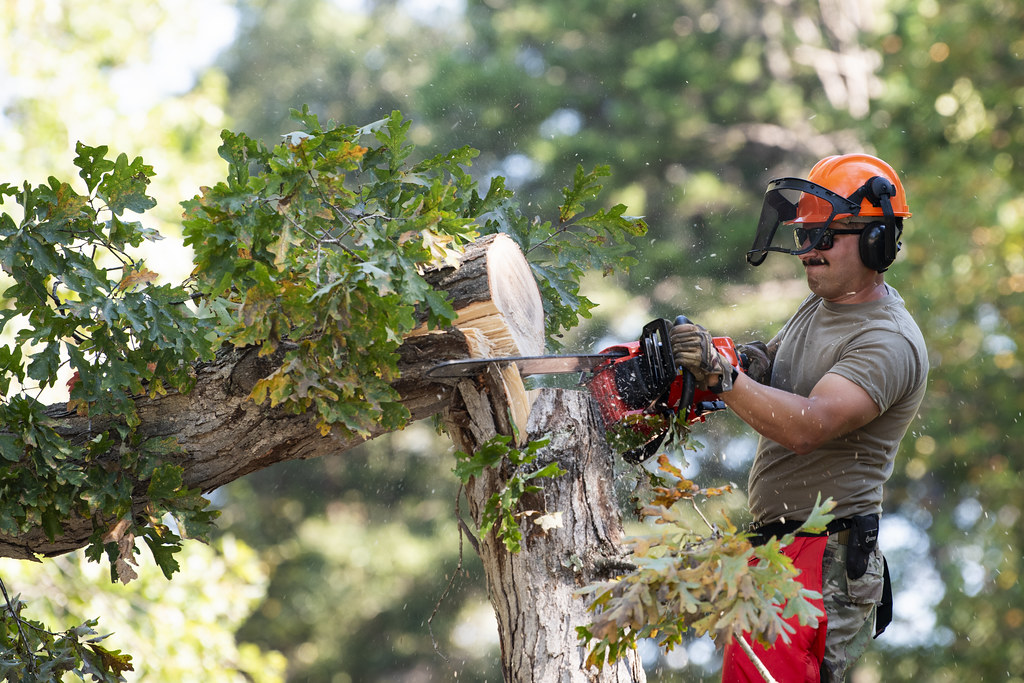
Where there is a landing zone, a removal is a felling job and a cleanup job: the face cut and back cut, the trunk laid out along the line the sawyer chose, then bucking, chipping, and raking until the lawn is a lawn again. Most of a day at the outside, and often just a morning. Where there is no landing zone — which on the hillside streets of Hot Springs and the terraced lots of Lake Hamilton is the rule, not the exception — the tree is dismantled in the air instead. A climber or a lift works from the top down, limbs are tied off and lowered on rope, and the trunk comes down in rounds sized to what the ground below can take. Same tree, twice the hours, and the reason the bands on this page spread as wide as they do.
Before the truck arrives, settle two things that are cheaper to decide now than later. Whether the stump goes with the tree — grinding in the same visit beats paying a second mobilization for it next month — and whether this removal is answering a buyer's inspector or an insurance letter, in which case the Garland County deadline-work page explains the documentation that has to come with the invoice.
Not on private ground. Hot Springs' tree ordinance reaches trees in the public right-of-way, where pruning needs a permit, topping is prohibited, and removals go through the Urban Forester. Inside Hot Springs Village the POA applies its own test by lot size and trunk diameter, and the shoreline strips on Lake Hamilton and Lake Ouachita belong to the utility and the Corps respectively. Name the exact spot when you ask for the quote and the pro will tell you which rule, if any, applies.
An open-ground pine or oak, yes — often by lunch. A tree that has to be rigged down over a house on a slope can run into a second day, and the quote will say so in advance rather than after.
Yes, and it saves money: rounds left stacked cost less than rounds chipped and hauled. Note that ash cut anywhere in Arkansas stays inside the state under the borer quarantine, which matters to nobody who burns it at home.
Want the actual figure instead of a band? A Garland County pro will walk the lot for free.
Call (501) 264-5001 Use the Form